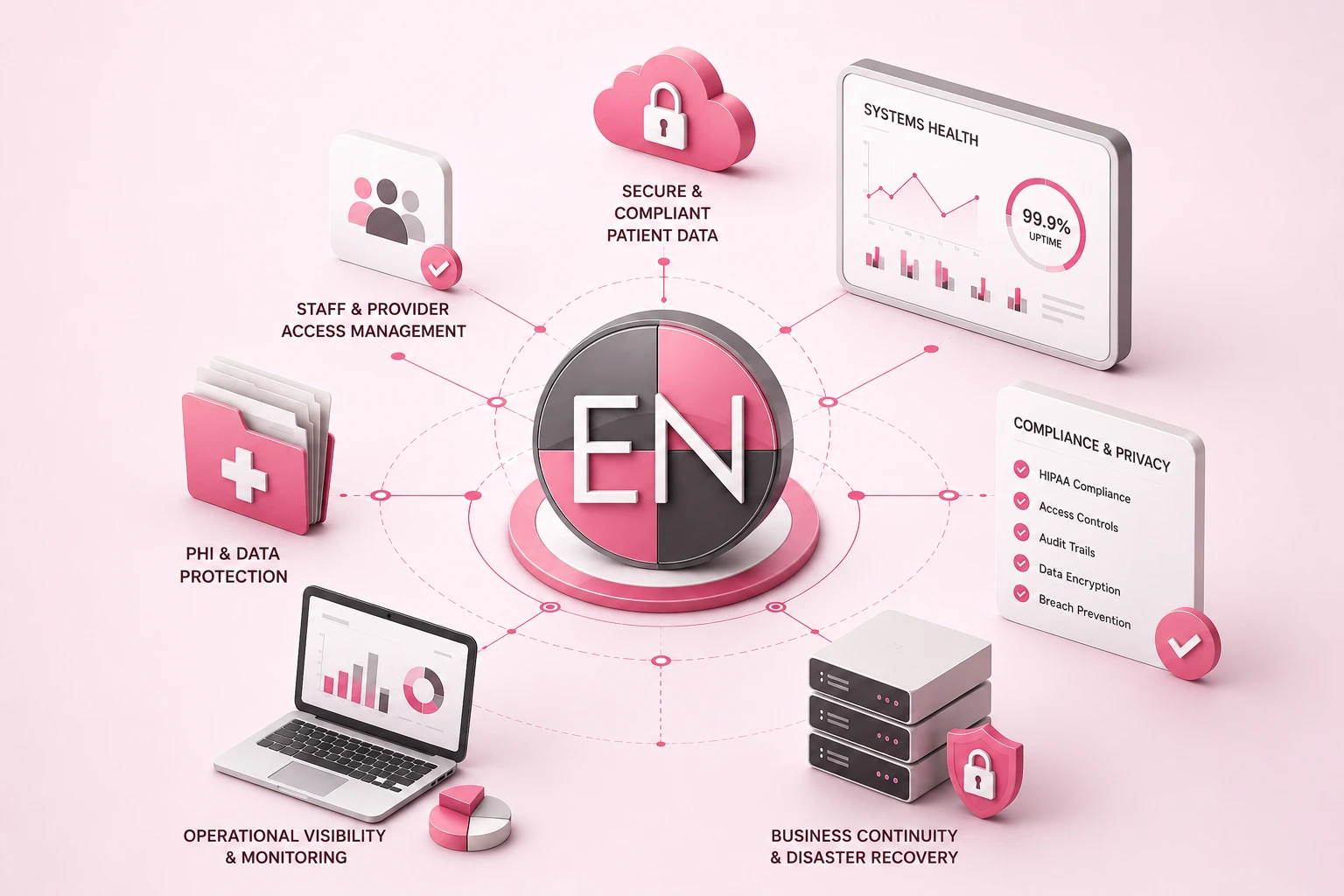





Introduction: healthcare operations depend on reliable systems
In healthcare environments, downtime quickly becomes patient-impacting operational risk.
Clinical and administrative teams need stable access to records, communication systems, and scheduling tools.
Our model focuses on operational reliability, clear ownership, and practical risk reduction.
Security: protect patient and operational data
Healthcare organizations remain a high-value target for phishing, credential abuse, and ransomware.
We prioritize identity controls, endpoint protection, and containment readiness tied to real system dependencies.
Security becomes measurable, repeatable, and aligned to day-to-day operations.
Productivity: reduce friction across care and admin teams
Workflow friction in check-in, referrals, and charting accumulates into lost time and staff stress.
We improve support responsiveness, endpoint consistency, and collaboration reliability.
Teams spend less time troubleshooting and more time on patient and business priorities.
Compliance: support HIPAA-aligned operational routines
Compliance gaps are often operational: inconsistent controls, weak evidence trails, or unclear ownership.
We align technical safeguards with practical routines and recurring review cadence.
Leadership gains better readiness for audits, due diligence, and incident response.
Scalability: grow sites and staff without control drift
Expansion can fragment standards across locations and teams.
We establish repeatable onboarding, access, and monitoring patterns.
Growth becomes more predictable without increasing unmanaged risk.
Expertise: engineering support shaped for healthcare pressure
Healthcare teams need IT partners who can balance urgency, security, and continuity.
Our engineers provide direct escalation ownership and practical decision support.
You gain steadier operations with clearer accountability.