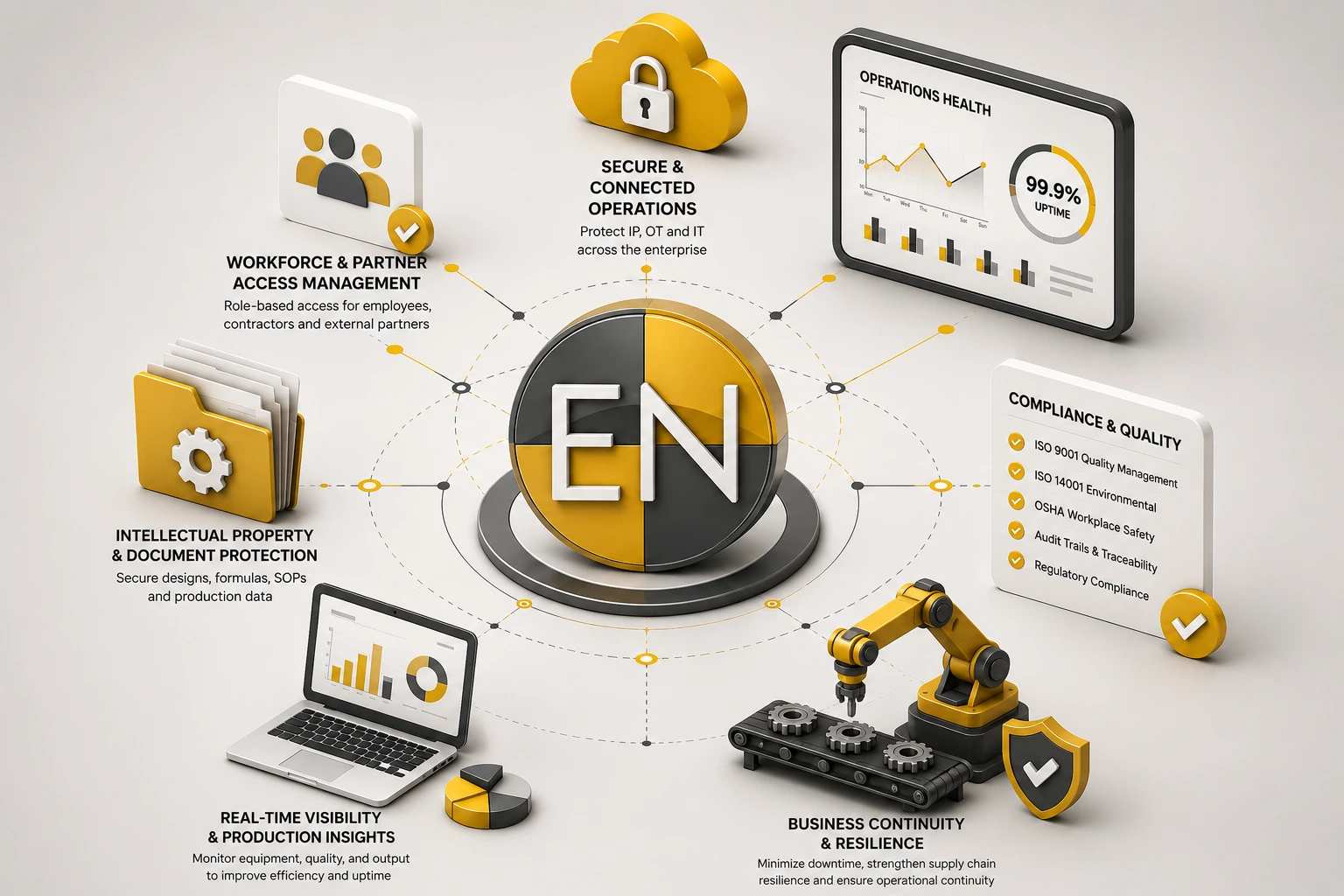





Introduction: uptime is an operational requirement
Manufacturing teams depend on stable systems to keep production moving.
Unexpected outages affect scheduling, output, and customer commitments.
We focus on reliability, ownership, and structured recovery readiness.
Security: reduce exposure across operational systems
Manufacturing environments face heightened ransomware and identity abuse risk.
We strengthen access controls, endpoint standards, and monitoring coverage.
Security improvements are tied to real operational dependencies.
Productivity: reduce recurring operational friction
Small recurring technical failures create large cumulative production impact.
We improve support workflows, endpoint consistency, and issue resolution paths.
Teams spend less time firefighting and more time executing.
Compliance: align controls with audit and customer expectations
Compliance readiness often fails in execution, not policy.
We map controls to repeatable routines and evidence-ready documentation.
You gain stronger audit confidence and clearer accountability.
Scalability: expand without operational drift
Growth can introduce inconsistent standards across sites and teams.
We build repeatable onboarding, access, and monitoring patterns.
Expansion remains controlled without adding unmanaged risk.
Expertise: engineering support for production-critical environments
Manufacturing teams need practical engineering guidance under real-time pressure.
Our model provides direct escalation ownership and structured response.
You get clearer decisions and steadier operations.